
The Value Creation Formula
How organisations convert capability into enterprise value.
Why a Value Creation Formula?
Most organisations measure performance.
- Revenue growth.
- Margins.
- Customer metrics.
- Operational efficiency.
These numbers tell us how a business is performing today.
But they do not fully explain why some organisations continue to improve while others stall, even when their capabilities appear similar.
The Value Creation Formula offers a way of thinking about this difference.
It is not a mathematical equation.
It is a conceptual lens that highlights how capability, leadership and organisational alignment interact to create lasting value.
The Value Creation Formula
Value = (Clarity + Capability + Customer Fit) × Leadership Attitudeᵒ
Where O represents Orchestration of Ownership
Orchestration of Ownership is the extent to which decision rights, judgement, and accountability are distributed across the organisation within a shared direction.
Most organisations focus on improving the components on the left-hand side.
But value rarely deviates from base performance unless decision rights shift.
The difference isn’t coordination. It’s whether people are trusted to interpret, decide, and act - within a shared direction.
AI accelerates this shift.
Not by replacing judgement, but by distributing it.
Base Performance
Every organisation operates from a baseline that reflects how well it functions in the present.
Base Performance = (Clarity + Capability + Customer Fit)
These three elements describe the organisation’s competence.
Clarity
Do your people really understand what matters most?
Clarity includes:
- Shared priorities
- Clear strategy
- Aligned metrics
- Coherent communication.
Without clarity, effort disperses across the organisation.
Capability
Does the organisation have the ability to deliver consistently?
Capability includes:
- Operational systems
- Technical expertise
- Execution discipline
- Organisational capacity.
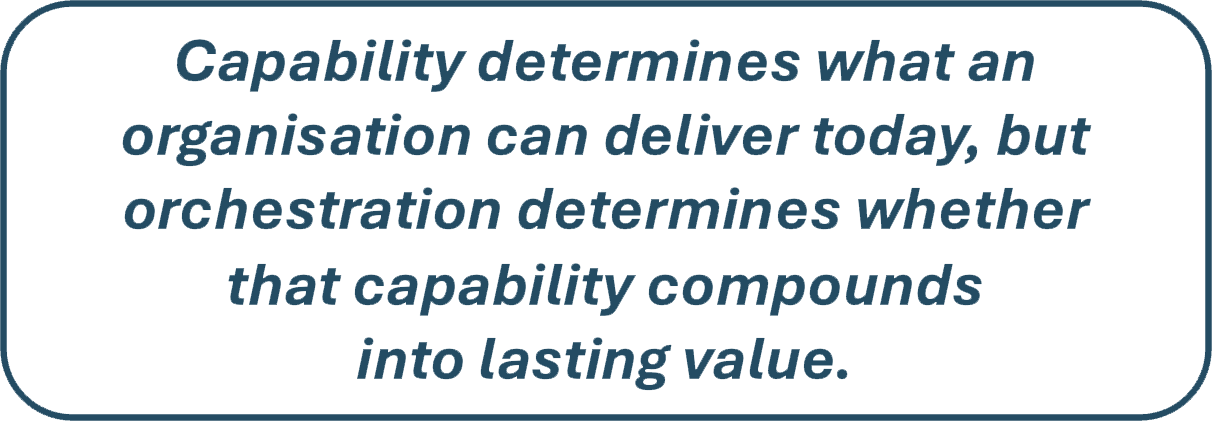
Capability determines what the organisation can reliably achieve.
Customer Fit
Does the organisation create value that customers genuinely recognise?
Customer fit exists when:
- The product solves real problems
- The offer aligns with market demand
- Customers return and recommend.
Without customer fit, capability produces activity rather than value.
These three elements form base performance. They define what the organisation can deliver today.
Most management effort focuses here.
The multiplier: leadership attitude
The exponent: orchestration
Beyond base performance sits something less visible but equally powerful.
Leadership attitude.
This reflects the intent and orientation leadership brings to the organisation.
It includes:
- Belief in the organisation’s direction
- Discipline in execution
- Consistency of priorities
- Willingness to confront reality.
Leadership attitude provides the signal that guides the organisation.
But intent alone does not produce value.
For intent to matter, the organisation must be able to interpret and coordinate around it.
This is where the model becomes non-linear.
The exponent in the formula represents orchestration.
Orchestration describes how the organisation aligns around leadership intent.
It includes:
- Decision structures
- Operating rhythms
- Behavioural norms
- Communication patterns
- Cross-functional coordination.
In other words:
How leadership signals travel across the organisation.
Why orchestration matters
Small differences in alignment can produce large differences in outcomes.
When orchestration is strong:
- Decisions travel faster
- Teams act with confidence
- Signals are interpreted consistently
- Feedback loops close quickly.
Momentum builds.
When orchestration is weak:
- Priorities fragment
- Decisions escalate unnecessarily
- Teams second-guess leadership intent.
Capability exists, but value stalls.
From performance to momentum
This is the central idea behind the formula.
Base performance determines what the organisation can do today.
Orchestration determines how consistently it can keep doing it tomorrow.
In that sense, the formula describes the movement from efficiency to effectiveness.
Why this matters in the AI era
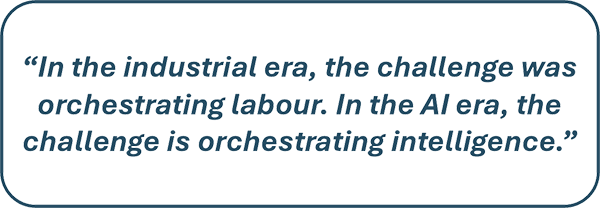
Artificial intelligence is dramatically increasing the amount of intelligence inside organisations. Data systems, predictive models and automation tools continuously generate insight.
But insight alone does not create value.
Value appears when intelligence changes judgement and judgement shapes decisions. That is why the ability to orchestrate intelligence across the organisation becomes so important.
It is also why Thinking in Fields focuses on Decision Architecture.
Because decision structures are one of the primary mechanisms through which orchestration occurs.
A different way to think about value
The formula suggests that organisations rarely fail because capability disappears.
More often they stall because leadership attitude and organisational orchestration fall out of alignment.
When that happens:
- Decisions slow
- Ownership weakens
- Accountability is lost
- Systems become defensive rather than adaptive.
Performance may remain visible for a time. But momentum fades.
The deeper point
Performance shows what the organisation is achieving today. Orchestration determines whether it can continue achieving it tomorrow.
The organisations that create enduring value are rarely those with the most intelligence or the most capability.
They are the ones where leadership intent and organisational alignment compound over time.
Connection to Decision Architecture
Decision Architecture is one of the most practical ways to improve orchestration.
It examines:
- Where intelligence enters the organisation
- Who interprets it
- Where decisions sit
- How authority flows.
When decision architecture improves, orchestration improves.
And when orchestration improves, capability begins to compound into value.